By Rachel Coy-Mecurio
The abrupt shift from crop land to manicured lawns or to the clean lines along woodlots seem to be more prevalent today than ever. Transitional areas, or buffers between landscape types, have slowly disappeared. By softening the edges that currently exist and providing a gradient in species composition and structure, we give an advantage to wildlife that need additional coverage from predators, improve species diversity, and support other services like improving water quality. Edge feathering is a technique used by landowners to re-create transitional zones between different habitat types.
Edge feathering can be accomplished through a combination of approaches like thinning over-story trees, allowing natural regeneration to take place, or by planting species that complement your goals. If you plan to feather into a woodlot, selective cuts and manipulation of the mature trees should be completed. Cut sick or undesirable tree species, as well as any trees that exceed 4 to 8 inches in diameter. Some of the selected trees can be girdled and left standing as snags, while others can be carted away and made into brush piles to further benefit wildlife on the property. If feathering into an open space, patience is needed while waiting on seed bed germination – planting plugs or saplings can help woody vegetation establish quicker.
If you plan on planting trees and shrubs, or allowing the seed bed to sprout, site preparation may be needed, depending on the vegetation currently growing. If turf grasses or invasive species are present, herbicide may be needed to create space and resources for the desired tree and shrub establishment to take place. Edges are great hosts to species that do not perform well in mature forests, due to the lack of resources that are able to penetrate the dense forest over story, or do not survive the constant disturbance needed in a perennial herbaceous stand. Often, these are soft mast producers like Rubus, or fruit trees.
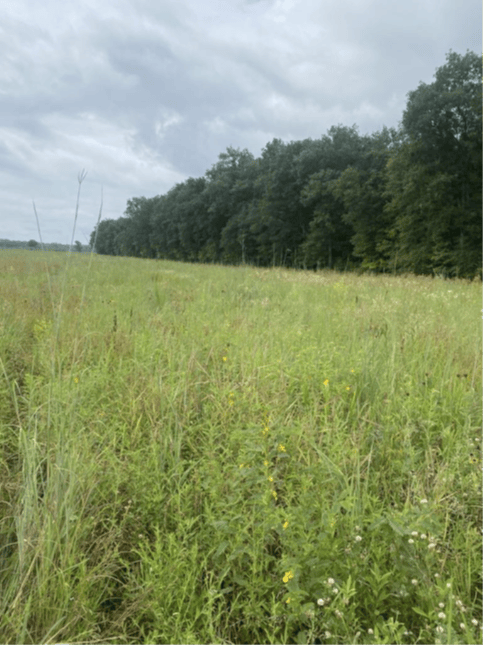
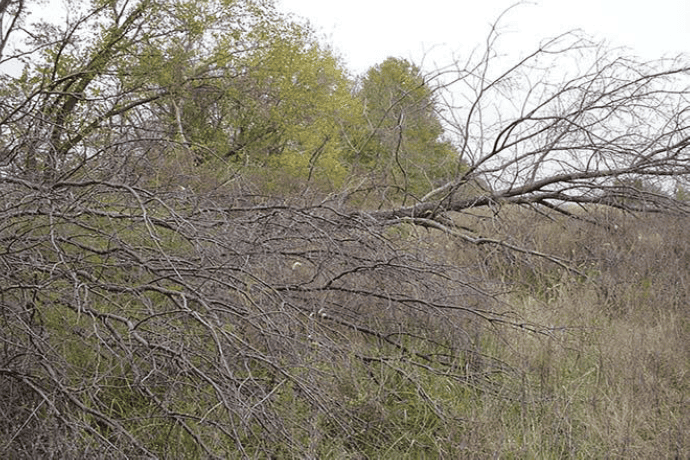
Edge feathering can be simplified into three zones of management. Your three zones will all fit into a 50 to 150 foot wide space and will include:
- Taller trees/shrubs (75% tree cover, approximately 10×10 foot spacing)
- Smaller trees/ shrubs (50% tree cover, 6×6 foot spacing)
- Herbaceous grass and forb zone (<25% woody cover)
The best time to treat and begin implementing a feathered edge is in the fall/winter after leaves fall off. After the edge has been established, continued management will be needed to ensure succession does not continue its course into young forest habitat. Control of any invasive species that had infiltrated the edge should be completed annually. The denser wooded areas should be re-treated when tree diameters exceed the threshold of approximately 8 inches. The grassy area should be managed on a 3-to-5-year cycle to prevent excessive woody encroachment and to continue to provide that smooth transition.
If you find yourself in a situation where the property you manage has a singular habitat type and you would like to increase resources available to wildlife on your property, practices like woodlot openings or shrub plantings within your grassland can help address these goals, too. If you are interested in implementing any of these practices on your property, reach out and I would be happy to offer additional, site-specific guidance.
| Pollinator Trees | Wet Loving | Shade Tolerant | Wildlife Shrubs | Deer Trees |
|---|---|---|---|---|
| Flowering dogwood | Bald cypress | Eastern red cedar | Eastern red cedar | American hazelnut |
| Eastern redbud | American beech | Eastern redbud | Willow (native, not hybrid) | Flowering dogwood |
| Black cherry | Swamp white oak | Pawpaw | Dogwood | Redbud |
| Hackberry | Sycamore | Dogwood | Silky dogwood | American plum |
| American holly | Buckeye | Spicebush | Redbud | Crabapple |
| Plum | Pawpaw | Buckeye | American plum | Serviceberry |
| Tulip poplar | Hackberry | Serviceberry | Crab apple | Elderberry |
| Eastern red-cedar | Elderberry | Witch hazel | Hawthorn | Swamp white oak |
| Blueberry | Eastern hemlock | American hazelnut | Spicebush | |
| Birch | Birch | Serviceberry | Pawpaw | |
| Willow | Cottonwood | Sumac | Blueberry | |
| Pawpaw | Eastern red cedar | |||
| Sassafras | Pine (for windbreaks) | |||
| Wild black cherry |